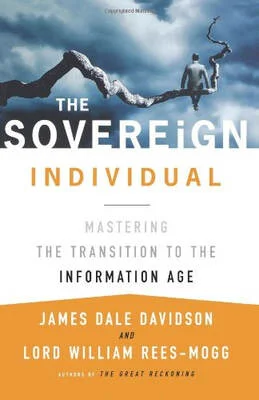
Sovereign Individual
concept · 1997
The Sovereign Individual is the 1997 book by James Dale Davidson and William Rees-Mogg, and the thesis it argues: information technology will dissolve the nation-state's monopoly on the most consequential aspects of life. The authors predicted that strong cryptography and frictionless digital communication would let individuals exit national tax bases and jurisdictions, producing a fourth great transition in human governance after the hunter-gatherer, agrarian, and industrial epochs.
The mechanism the book identifies is the changing economics of violence. Earlier transitions were shaped by what it cost to project force — agriculture made land worth taxing, industry made armies cheap enough to defend it. Information technology inverts both ratios. Strong cryptography makes wealth defensible without an army, remote work makes labour location-independent, portable digital assets make exit cheap. The predicted result is a long unwinding of the nineteenth-century state and the emergence of new sovereign units organised around shared interest rather than shared territory.
The book is a foundational reference in the cypherpunk-libertarian canon, read alongside the cyphernomicon and Crypto Anarchist Manifesto as a text the movement folded into its own predictions, and the network-state discourse picks up the same thread. Its politics are contested — the cognitive-elite framing edges toward plutocracy, and critics argue the model underplays the persistence of state coercive capacity. The architectural claim, that the costs of exit are about to fall sharply, has held up better than most late-twentieth-century commentary.
Tento termín zatím nebyl přeložen.